Construct Definition
Operationalizing social masking as deliberate or automatic suppression of spontaneous affect and effortful maintenance of normative facial/vocal cues.
Construct RigorResearch & Validation Program
NDMS translates affective computing and neurodiversity research into a testable, reproducible system with physiological validation, ablation studies, and strict safety guardrails.
Methodological Rigor
All metrics and accuracy targets represent planned research goals unless supported by empirical dataset publication.
Operationalizing social masking as deliberate or automatic suppression of spontaneous affect and effortful maintenance of normative facial/vocal cues.
Construct RigorMulti-rater clinician annotations, self-reported retrospective effort tags, and task-induced cognitive/social stress protocols.
Ground TruthSystematic ablation tests comparing face-only, voice-only, unweighted fusion, and dynamic quality-gated fusion across datasets.
Ablation ScienceEvaluating expected calibration error (ECE), ROC-AUC, and precision-recall curves to ensure scores represent true probabilistic evidence.
Statistical MetricsTest-retest evaluation across repeated social interaction sessions to confirm temporal stability and low within-person variance.
RepeatabilityAudit slices across gender, age, ethnicity, regional accents, lighting levels, and diverse neurodivergent communication profiles.
Bias ControlsProfiling sliding window buffering, feature extraction latency (latency profiling / target to be preregistered), memory footprint, and mobile battery usage.
Edge ProfilingQualitative user studies evaluating perceived agency, emotional clarity, fatigue recovery rate, and absence of anxiety/stigma.
User Benefit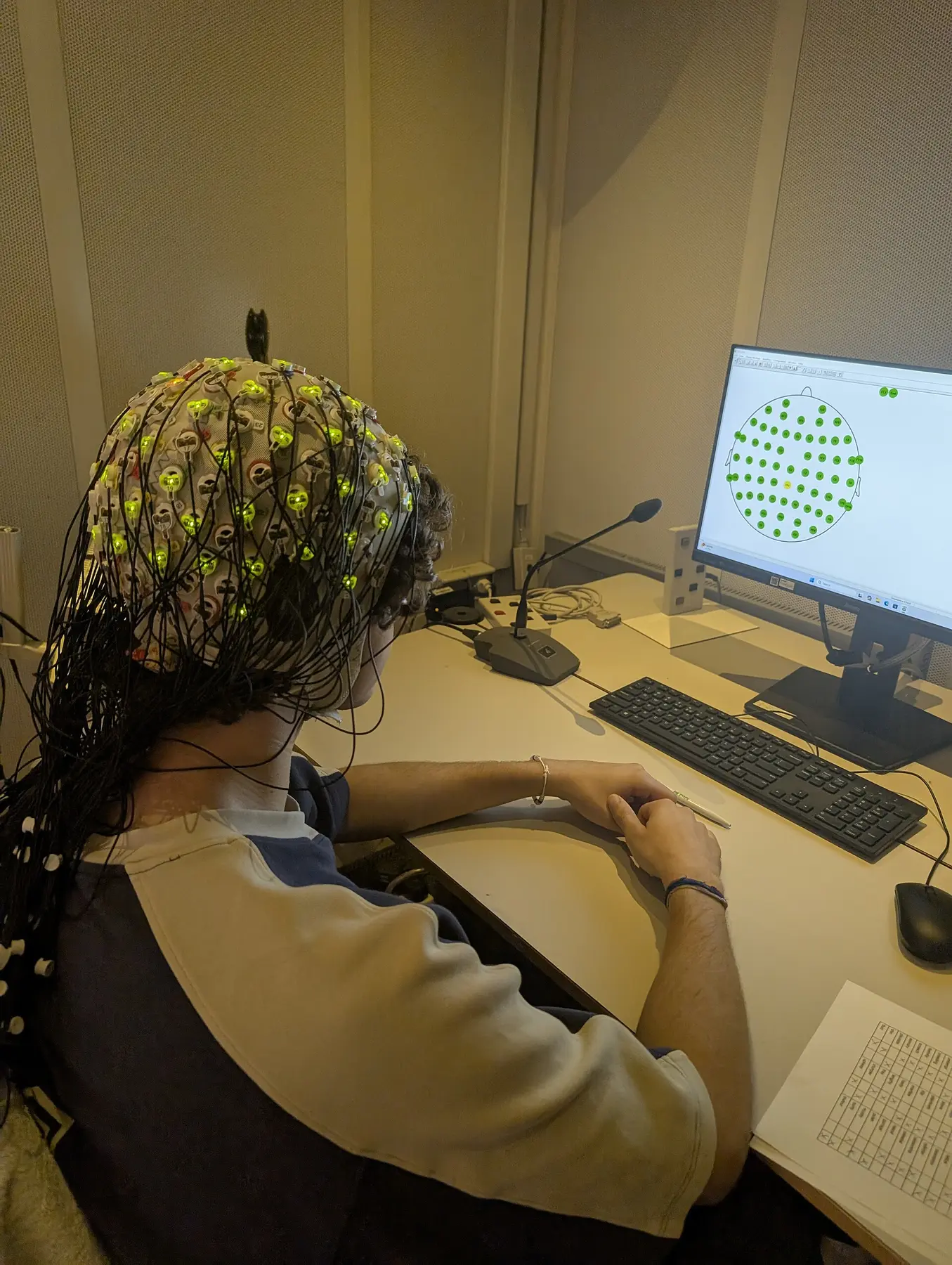
EEG Boundary & Knowledge Distillation
A core scientific innovation of NDMS is using multi-channel EEG during initial laboratory training as a high-fidelity physiological "teacher."
Through teacher-student knowledge distillation, the student model learns to detect latent stress and masking signals using only audiovisual inputs—eliminating the burden of headwear or sensors for everyday end users.
Laboratory Teacher Model → Audiovisual Student ModelEvaluation Matrix
Validation domains and metrics will be explicitly preregistered in formal study protocols prior to clinical and public beta trials.